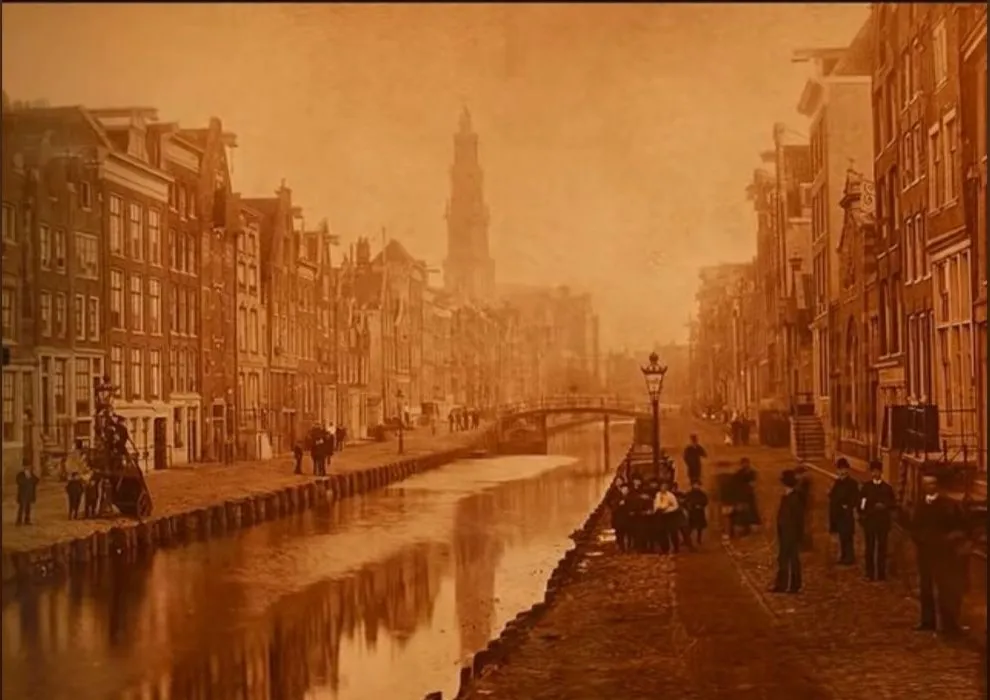
The Rozengracht when it was still a canal: an old photograph of the water with houses on both sides and people on the quay.

History of the Rozengracht

A walk through the history of the street, in order of house number, from the Westermarkt to the Marnixstraat. Pick a stop on the left, and read the full story on the right.

By house number
By period
← All history
Story

Rozengracht 95–105: 't Lootsje, home of the liqueur distillery

Rozengracht 95–105 vanaf 1892

For a long time the Rozengracht was home to a liqueur distillery, and you can still see it. At numbers 95 to 105 stands the complex known as 't Lootsje: the office and tasting room of the Bols distillery.

The first part was rebuilt in 1892 by H.P. Berlage. From 1902 Eduard Cuypers extended the complex. Two well-known architects, then, working on a single building.

Bols had a second address on the Rozengracht, a bit further along: the former IJsland factory at numbers 204 to 210.

Direct link to this story →
← All history
Story

The Rozentheater: from Amsterdam's first cinema to international comedy venue

Rozengracht 117 1913 to now Now: Boom Chicago

Long before Tuschinski existed, the building at Rozengracht 117 was already Amsterdam's largest cinema. It opened in 1913 under the name Asta, later Capitol, then Mickery Theater, and finally, in 1994, Rozentheater again.

Today the Rozentheater is home to Boom Chicago, the international improv comedy company that moved in during 2013. From that group came Seth Meyers, Jordan Peele, and the creators and stars of Ted Lasso.

The building has three stages: the main hall seats 350, the first-floor theatre holds 120, and the attic stage fits just 35. More info via www.boomchicago.nl.

Direct link to this story →
← All history
Story

Rozengracht 133: from a Jesuit hall to an underground club

Rozengracht 133 1929 to now Now: Chin Chin Club

There's no cross on the facade of Rozengracht 133 anymore. Yet this building has a past that goes back much further than most Chin Chin Club visitors would guess.

The building opened in 1929 as the Roman Catholic association hall "Joannes Roothaan," named after the Amsterdam-born Jan Roothaan, who became the highest official of the Jesuit order in 1829. Architect H.W. Valk designed it, along with the neighbouring De Zaaier church.

In 1955, a talent contest here crowned Johnny Jordaan and Tante Leen as the Best Voice of the Jordaan. When De Zaaier closed in the 1970s, the Roothaanhuis lost its Catholic role too. It became a community centre hosting student parties, billiards tournaments and band nights. In 1999, the Balkan Peace Coalition held its founding meeting there.

Around 2000, Club More opened in the building, with house music and Rewind Parties for the crowd left behind when the Roxy closed. In 2013, fish restaurant Pesca moved in, and in 2017 Chin Chin Club claimed the basement below it: a raw space converted into restaurant, karaoke bar and nightclub at once.

From Jesuits to karaoke, in under a century. More info via chinchinclub.nl.

Direct link to this story →
← All history
Story

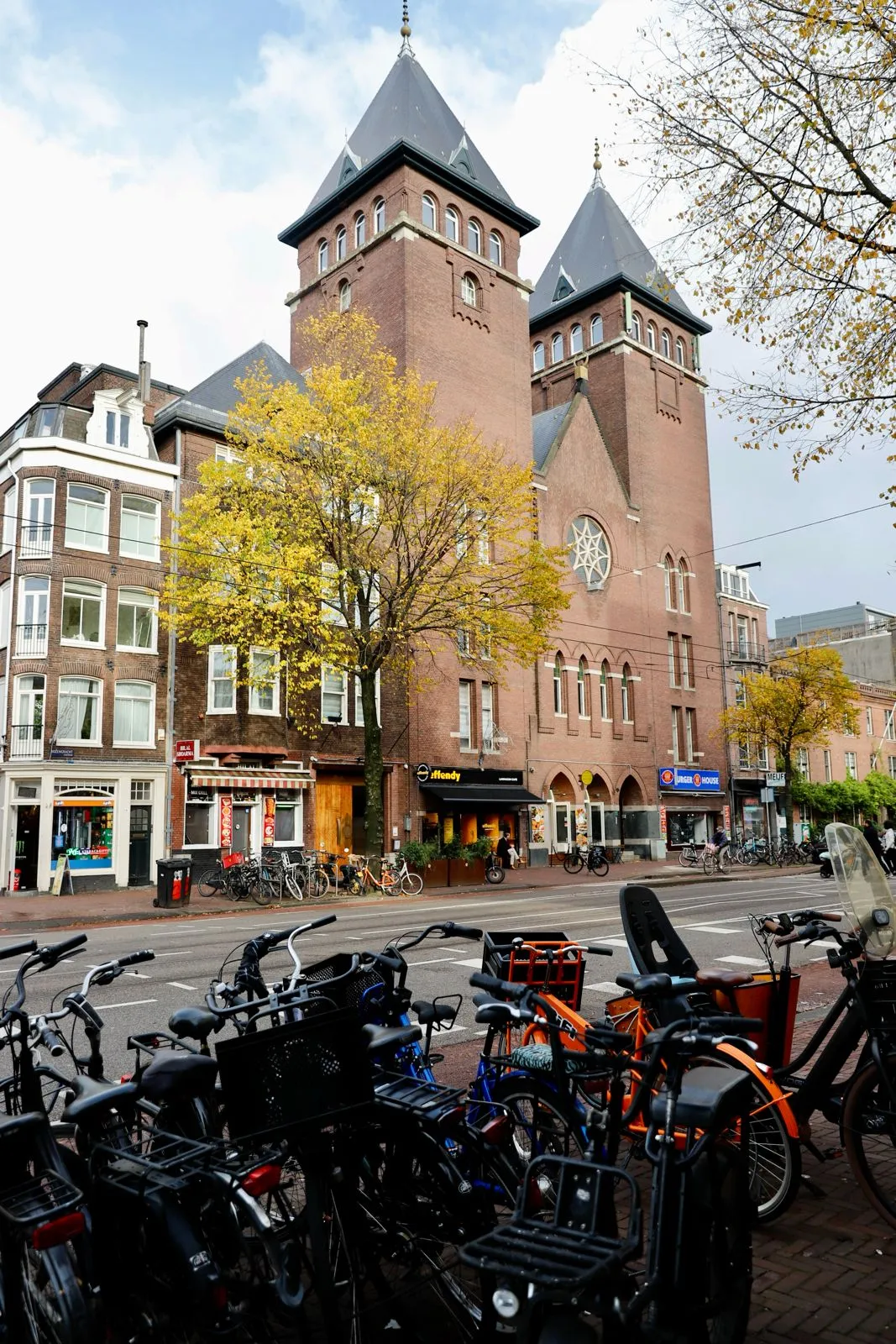
The Fatih Mosque: a church that is no longer a church

Rozengracht 150 1927 to now
The Fatih Mosque: a church that is no longer a church

Walking along the Rozengracht, you'll notice a building at number 150 that doesn't quite fit. Two towers, arched windows, patterned brickwork in yellow, red, and blue: this looks like a church. It used to be one. For more than 45 years, it has been the Fatih Camii: Amsterdam's largest mosque.

The building was constructed in 1927–1929 as the Sint Ignatiuskerk, known as De Zaaier. The last mass was held in 1971. In 1980 the Turkish community bought the building.

Inside, the church structure is almost entirely intact. The mihrab now stands where the entrance used to be. More info via fatihcamii.nl.

Direct link to this story →
← All history
Story

Rembrandt's last house: Rozengracht 184

Rozengracht 184 (gedenkplaat) 1658 to 1669

On the facade of Rozengracht 184 hangs a small memorial plaque. "Here stood Rembrandt's last residence, Anno 1669." This address marks the end of one of the greatest painting careers Amsterdam has ever produced.

Rembrandt van Rijn moved to the Rozengracht in 1658, after declaring bankruptcy. He was 52. He stayed until his death on 4 October 1669.

Four days later, on 8 October 1669, he was buried at the Westerkerk, less than a ten-minute walk from his last home.

Direct link to this story →
← All history
Story

The hofjes of the Rozengracht: hidden quiet in the Jordaan

Rozengracht 190 1737 & 1744

Follow the house numbers along the Rozengracht and step through the occasional gate, and you'll find a world that shuts out the street entirely. The hofjes of the Jordaan are among Amsterdam's best-kept secrets, and two of the finest are on or just behind the Rozengracht.

Rijpenhofje: On the Palmgracht, just behind the Rozengracht, sits the Rijpenhofje. It was founded in 1737 with money from the estate of Gerard van de Rijp, a Mennonite merchant.

Rozenhofje: On the Rozengracht itself at number 190 is the Rozenhofje. In 1648 this site was home to Het Nieuwe Doolhof. In 1744 the grounds were converted into a hofje: 55 homes for Mennonite elderly women.

Neither hofje has fixed public opening hours, but if you arrive quietly and ask politely, you may find the gate ajar.

Direct link to this story →
← All history
Story

Rozengracht 204–210: the IJsland factory, also a Bols building

Rozengracht 202-210 vanaf 1919 Now: Studio HENK

At numbers 204 to 210 stood a factory called IJsland. It began as a steam factory for kitchen and coffee syrup.

The company was wound up in 1919. The complex then passed to Erven Lucas Bols, who had it rebuilt. So this is also a Bols building, even though it originally had a different function from 't Lootsje at numbers 95 to 105: not a tasting room, but a factory.

Direct link to this story →
← All history
Story

Why the Rozengracht isn't a canal anymore

1889–1890
Why the Rozengracht isn't a canal anymore

The name still gives it away: Rozengracht, "rose canal." But walk here today and you won't find any water, just a broad road with tram tracks.

Until the late 19th century, this was one of six canals in the Jordaan, dug in the 17th century. The name belongs to a whole string of flower names across the western Jordaan: Bloemgracht, Lauriergracht, Egelantiersgracht. A theme from the era the neighbourhood was laid out.

The water in those 17th-century canals grew badly polluted over the 19th century and became a health hazard for the densely packed neighbourhood around it. The filling-in of the Rozengracht began in 1889 and was finished the following year. The city had a second motive too: Amsterdam needed a broad route out to the west, bypassing the Singel.

In 1895 the new street was extended further west as the De Clercqstraat. Nothing of the original canal is left to see. The name is about all that remains.

Direct link to this story →
← All history
Story

The first tram on the Rozengracht

1896 to now

Barely ten years after the canal was filled in, a tram was already running over the brand-new road. In 1896, the first horse tram set off on the Dam–Bilderdijkstraat route, straight across the Rozengracht.

That horse tram didn't stay a horse tram for long. In 1900 the line was extended to Eerste Constantijn Huygensstraat, and in 1902 it switched entirely to electric power: from then on known as line 3.

More than a century later, a tram still runs along the Rozengracht, today lines 13 and 17. The horses are gone and the numbering has changed, but the route has stayed remarkably faithful to the one laid out in 1896.

Direct link to this story →
← All history
Story

Rembrandt wasn't the only painter on the Rozengracht

1650–1673

Everyone knows the story of Rembrandt at Rozengracht 184. Less well known: in those same years, at least three other Golden Age painters lived just a few hundred metres away.

Adam Pynacker. The landscape painter lived on the Rozengracht from 1661 until his death in 1673: exactly the years Rembrandt spent making his last work here too.

Meindert Hobbema. Mill painter Hobbema, a pupil of Jacob van Ruisdael, moved with his family to the Rozengracht in the Jordaan around 1668, the same lean years Rembrandt spent there.

Ludolf Bakhuizen. The seascape painter moved house at least six times in his life, from Haarlemmerstraat to Herengracht. One of the addresses in between: the Rozengracht.

Johannes Lingelbach. His father started a doolhof, a 17th-century pleasure garden, on the Rozengracht in 1646, on the spot where the Rozenhofje now stands. Johannes grew up there himself, until he moved to the Reestraat in 1662.

An ordinary shopping street with an unusually dense cluster of painters, in other words, long before anyone put up a plaque for it.

Direct link to this story →
← All history
Story

What exactly is the Oranje Loper?

2022 to now

Anyone who's walked the Rozengracht in the past few years has run into the construction fencing. It belongs to the Oranje Loper: a long-running project by the City of Amsterdam to overhaul the entire corridor between the Raadhuisstraat and the Mercatorplein.

The real work sits under the street: cables and pipes for power, data, gas, water and sewage, some decades old, are being replaced. Above ground, bridges are being tackled, including the Jordaanbrug, which is being rebuilt from scratch, and junctions like the Westermarkt and Rozengracht/Marnixstraat are being redesigned.

Work began in 2022 and is split into phases by street section, so the whole route doesn't have to be dug up at once. The Rozengracht is one of the later stretches: the municipality reported picking construction back up here in 2026.

For the businesses along the street, this mostly means temporary detours and shifting accessibility, with a fully renewed infrastructure under their own front door as the payoff.

Direct link to this story →